Japan is rapidly becoming one of the most regulated and fast-growing solar panel recycling markets in the world. For investors looking to build a solar panel recycling plant in Japan, 2026 is the right time to enter. Driven by strict MOE regulations and a rising volume of end-of-life PV modules, the demand for PV recycling in Japan has never been higher.

This case study explains how a Japanese investor planned and established a solar panel recycling management, including regulatory drivers, technical selection, investment comparison, and profitability analysis.

How Japan’s Recycling Regulations Are Driving PV Recycling Demand?

Japan’s solar recycling market is no longer optional, because it is becoming legally mandatory. In 2025-2026, two major policy updates significantly accelerated demand:

  • On November 12, 2025, Japan’s Ministry of the Environment issued the Waste Solar Panel Treatment Standards, based on the Circular Resource Recycling Promotion and Advanced Recycling Business Act. This regulation strengthened disposal responsibility and officially promoted industrial-scale recycling systems.

  • On April 3, 2026, the Japanese Cabinet approved the Solar Panel Waste Resource Circulation Promotion Bill, which requires large solar operators to submit disposal and recycling plans for end-of-life PV modules.

These policies are driven by a major forecast: Japan is expected to generate over 500,000 tons of waste solar panels by 2040, nearly six times current levels. As a result, Japan is shifting from landfill disposal to a mandatory recycling-oriented PV lifecycle system, creating strong demand for industrial PV recycling plants.

How to Choose a 1000kg/h Solar Panel Recycling Plant in Japan?

The client in this project is a recycling company based in western Japan, already operating in industrial waste processing. Their original goal was to build a photovoltaic recycling plant with flexible expansion capability, but their technical requirements were very specific:

  • Feedstock type: mixed single-glass and double-glass solar panels

  • Estimated ratio: 60% single-glass and 40% double-glass

  • Target capacity: 800-1200kg/h

  • Budget range: $700,000-$1,000,000 initially planned

  • Recovery requirement: high aluminum and glass recovery rate with stable silicon output

  • Key concern: reducing labor cost due to Japan’s high workforce expenses

One of the most important requirements was that the system must handle mixed module types without frequent shutdown or manual sorting bottlenecks. This requirement became the key factor in determining the final process design.

$800K vs $1.5M: Solar Panel Recycling Plant Cost Comparison in Japan

To determine the most suitable solution, we provided two main technical routes for comparison. Before comparing the $800K and $1.5M solutions, it’s essential to understand the key factors that influence various solar panel recycling machine cost.

Option A: $800,000 – Semi-Automatic Mechanical Line

Item Details
Technology route Manual frame removal → hammer crushing → air separation → electrostatic separation
Glass purity 90–95% (contains 5-10% backsheet/EVA residues)
Recovery rate 80–85%
Labor requirement 6–8 workers/shift
Dust control Pulse-jet baghouse
Best for Single-glass panels only; dual-glass causes lower throughput

Option B: $1.5M – Fully Automated Pyrolysis Line

Item Details
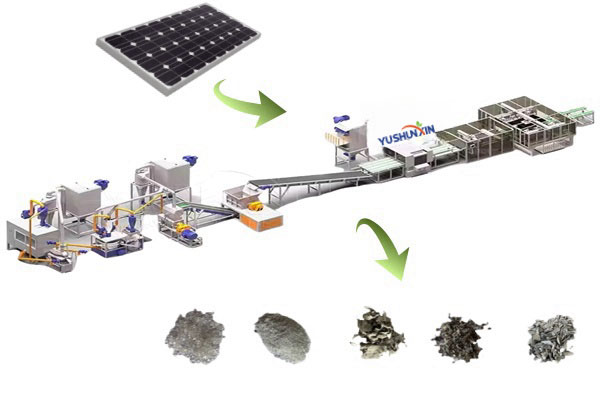
Technology route Automated frame removal → dual-shaft slow shredder → pyrolysis furnace → multi-stage hammer mill → air & density separation → eddy current separator (for Al/Cu) → electrostatic separator (for Ag/Si)
Glass purity ≥99% (clean glass, suitable for glass wool or bottle manufacturers)
Recovery rate Overall 92–95% (silver 80–85%)
Labor requirement 2–3 workers/shift
Dust & emission control Pulse-jet baghouse + activated carbon filter (meets Japan’s strictest standards)
Best for Specially designed for frameless dual-glass panels (common in Japanese agri-solar)

After technical and economic evaluation, the client chose a balanced hybrid configuration, but with selective pyrolysis only for difficult fractions, rather than full-scale thermal treatment. The final investment was controlled at $900,000 to $1.2 million for a 1000kg/h solar panel pyrolysis project solution. This solution provided the best balance between cost, efficiency, and regulatory compliance.

1000kgh solar panel recycling in japan

5 Mistakes to Avoid When Building a Solar Panel Recycling Plant in Japan

Based on actual failed projects and near-misses, here are five “avoid at all costs” mistakes.

Many Chinese/European suppliers still design lines for 95% single-glass panels. But Japan’s agrivoltaics (solar sharing) market uses frameless dual-glass panels.
Consequence: Dual-glass jams hammer crushers and blinds air separators.
Fix: Demand a dual-glass test run before purchase.

Japan’s Air Pollution Control Act (enforced by MOE) limits particulate matter to <100 mg/m³ in most industrial zones. Cheap recycling lines emit 300–500 mg/m³.
Consequence: Immediate operation suspension plus ¥1M+ fines.
Fix: Budget for a baghouse + wet scrubber, not just a cyclone.

Japanese glass buyers (e.g., AGC, NSG Group) require JIS R 5210 compliance for cullet. They reject glass with backsheet residues.
Consequence: You can’t sell glass locally; you pay to truck it to a landfill.
Fix: Install an optical sorter or density separator to achieve >99% glass purity.

Japan has thousands of abandoned or disaster-damaged panels (e.g., from 2024 Noto Peninsula earthquake). These often contain broken glass and moisture.
Consequence: Wet feed clogs electrostatic separators and corrodes conveyors.
Fix: Add a drying stage (low-temp rotary dryer) for damaged panels.

Under the Solar Cell Waste Recycling Promotion Act (2026), facilities with capacity >500 kg/h may be required to report silver recovery rates.
Consequence: You leave $50–$100/ton on the table.
Fix: Use an electrostatic separator specifically tuned for <1 mm silicon powder.

Is Solar Panel Recycling Profitable in Japan?

Let’s run the numbers for the fully automated solar panel recycling line at 1,000 kg/h, 2 shifts/day, 240 days/year.

Annual Throughput & Revenue from recovered materials (Japan prices, 2026)

Item Calculation Calculation Value
Annual throughput 1,000 kg/h × 16 h/day × 240 days 3,840 tons
Glass (70%, $60/ton) 2,688 tons × $60 $161,280
Aluminum (8%, $1,800/ton) 307 tons × $1,800 $552,600
Copper (2%, $8,500/ton) 77 tons × $8,500 $654,500
Silver (0.05%, $850/kg) 1,536 kg × $850 $1,305,600
Silicon powder (4%, $200/ton) 154 tons × $200 $30,800

Top Questions About Solar Panel Recycling in Japan

Yes, but not all solar panel recycling equipment can handle them. Bifacial panels have glass on both sides, requiring a dedicated double-glass solar panel recycling line. Mechanical cutting lines will damage the rear glass, so PV pyrolysis technology is recommended.

Under the 2025 MOE standards, you need:
1.MOE certification under the Act on Promoting Advanced Recycling Businesses
2.Glass quality certification
3.Environmental impact assessment approval
4.Carbon mass balance documentation (for thermal processes)
The 2026 bill adds a certified recycler designation that enables nationwide operation without prefectural permits.

Yes. AGC Inc. has publicly committed to purchasing high-quality recycled glass for flat glass production. In September 2025, AGC successfully used 20 tons of recycled cullet as raw material at its Yokohama Technical Center. Other buyers include: Nippon Sheet Glass, Insulation manufacturers (lower prices), Cement kilns (as silica source).

For a 1000 kg/h solar panel recycling plant, the equipment cost typically ranges from $800,000 to $1.5 million, depending on automation level and whether thermal treatment is included. Local installation, dust control upgrades, and MOE compliance add another 15-20%.

Under the 2026 Solar Cell Waste Recycling Promotion Act, operators must obtain MOE certification under the Act on Promoting Advanced Recycling Businesses. The new bill also introduces a certified recycler designation that allows nationwide operation without prefectural permits.