As global photovoltaic capacity installation continues to rise, a large number of early-installed photovoltaic modules will reach the end of their service life in the coming decade. New policies boost investment in PV recycling lines, creating unprecedented opportunities for their development.
What new policies are driving investment in PV recycling production lines?
Photovoltaic panels contain valuable materials such as glass, 알류미늄, 규소, and small amounts of silver and copper. 하지만, they also potentially contain harmful substances like lead and 카드뮴. Simply landfilling waste not only wastes resources but also creates risks of soil and groundwater contamination.
Based on this understanding, governments across the world have implemented new regulations and incentives to promote investment in 태양광 패널 재활용 관리. Hence, new policies boost investment in PV recycling lines.


As early as 2012, the European Union incorporated PV modules into the Waste Electrical and Electronic Equipment Directive (WEEE Directive), requiring manufacturers to assume responsibility for the recycling of these components. 게다가, they have set a recycling rate target of up to 85%. This has directly spurred investment in European recycling technologies and facilities.
The US Department of Energy (DOE) released the Solar Futures Study in 2023, indicating that the photovoltaic recycling industry will become a vital link in the clean energy chain over the next decade. California and Washington State have implemented Extended Producer Responsibility (EPR) systems, requiring the establishment of photovoltaic recycling programs while encouraging the use of equipment with high recycling rates.
China’s National Energy Administration has issued the Guiding Opinions on Accelerating the Coordinated Development of the Photovoltaic Industry Chain. 따라서, this policy calls for the establishment of a recycling system for retired photovoltaic modules. Japan’s Ministry of Economy, Trade and Industry (METI) released the “Guidelines for Renewable Energy Recycling,” which outlines standard procedures for 태양광 패널 분해 장비 그리고 물질 분리. South Korea’s Ministry of Environment has established a photovoltaic recycling demonstration base. 뿐만 아니라, this base aims to promote advanced models combining mechanical recycling and pyrolysis technology.
What Successful Cases Can Serve as References?
Driven by new policies, our photovoltaic recycling solutions successfully serve multiple global markets. Below are two representative project case studies.

Single-glass photovoltaic panels disposal project
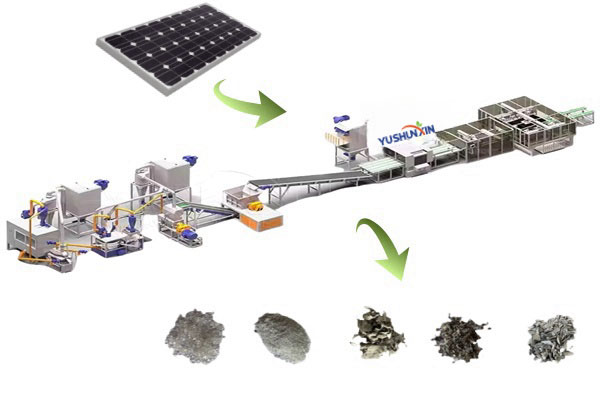
~ 안에 2022, we constructed a 1000kg/h photovoltaic panel recycling production line for a German client. This production line employs mechanical recycling processes, which separate glass, 규소, 알루미늄 프레임, and conductive materials from components through crushing and sorting. The entire process produces no secondary pollution, and consumes minimal energy.
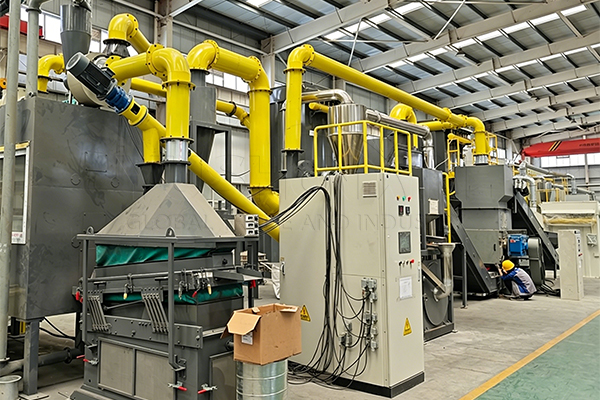
- Equipment Configuration: Automatic feeding system, crushing unit, 공기 분류기, 자기 분리기, optical sorting system, and dust removal system.
- Recycling Efficiency: Glass recycling purity exceeds 96%, and metal recovery rate surpasses 95%, which fully meets the recycling standards of EU.

태양광 패널 열분해 프로젝트 솔루션
~ 안에 2024, a client from Japan contacted us. They intended to invest in building a photovoltaic recycling production line with annual processing capacity of 5,000 톤. The process decomposes the EVA encapsulation layer in a pyrolysis furnace, and then uses mechanical equipment to separate the metal, 유리, 그리고 실리콘 웨이퍼.
- Equipment Configuration: 열분해로, exhaust gas purification system, cooling unit, and automatic sorting system.
- Recovery efficiency: Silicon recovery purity reaches 99%, and exhaust gases meet emission standards through the purification system.