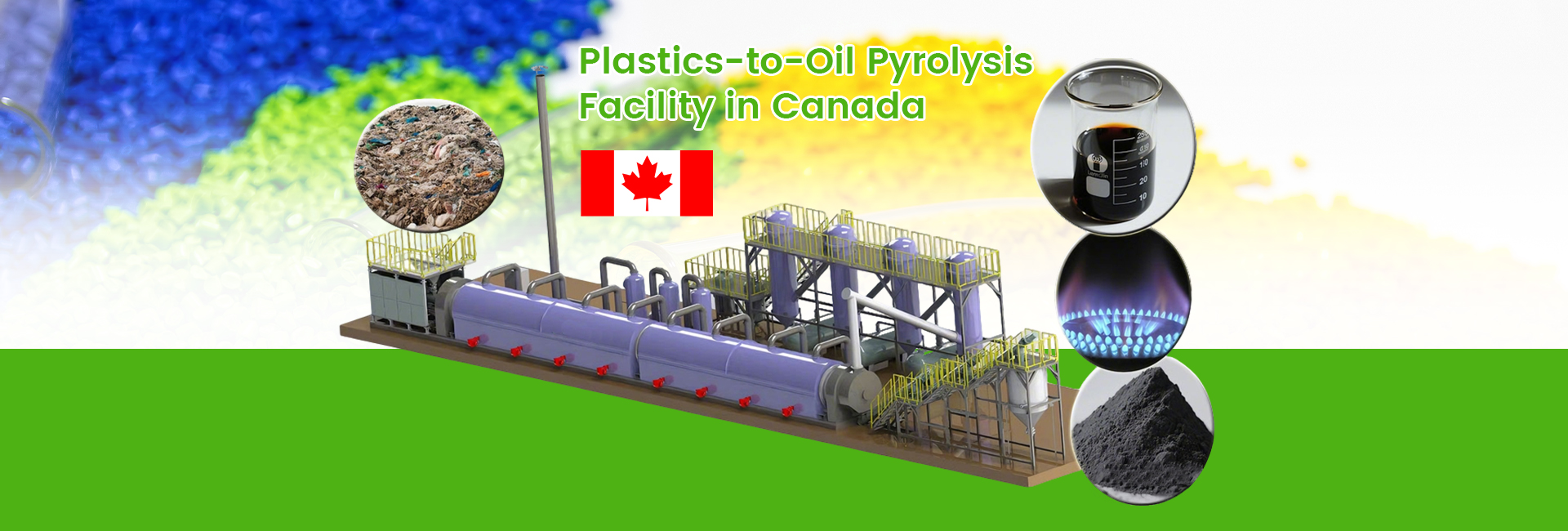
In the spring of 2023, we received an inquiry from an eco-friendly energy company from Ontario, Canada. This client had been in the municipal solid waste recycling business for many years. In the face of increasingly strict plastic waste management policies, they urgently needed a technological breakthrough. The Canadian government set a national goal of achieving “Zero Plastic Waste” by 2030 in 2020. Furthermore, it has implemented bans on single-use plastics and circular economy incentive mechanisms in all provinces. Ary noho izany, this client is seeking the plastics-to-oil pyrolysis facility in Cananda.
What is the customer’s biggest concern?
The client asked us, “ Is it really possible to legally implement this plastic pyrolysis technology in Canada?” We fully understand the client’s concerns. Canada’s environmental regulatory framework is stringent, particularly for projects involving waste disposal and energy recovery.

What Final Products Can a Plastic Pyrolysis Plant Produce?

Another important product is syngas, also called non-condensable combustible gas. This gas is usually not the main product for external sale. fa tsy, it can be purified and returned to the furnace as heating fuel for the pyrolysis reactor. This helps the plant reduce external fuel consumption and lower daily operating costs. For large-scale or continuous plastic pyrolysis projects, syngas reuse is an important part of the overall energy-saving design.
The third product is char residue. The quantity and quality of char residue depend on the plastic composition, ash content, additives, and contamination level. In some projects, it can be used as a low-grade solid fuel or sent to cement plants or brick factories for co-processing after testing. If the residue contains unsuitable impurities, it should be handled according to local environmental regulations. Ary noho izany, YUSHUNXIN usually recommends raw material sorting before feeding, especially removing metals, sand, stones, PVC, PET, and high-moisture contaminants.
Can the oil from pyrolysis truly generate economic value?
“Can this plastic-to-oil technology really turn a profit in the Canadian market?” This is a question many customers often ask. Although syngas and char residue also have reuse potential, pyrolysis oil is usually the main product that customers care about most. For a plastic pyrolysis project, the economic value of oil depends on three factors: local fuel demand, oil quality after condensation, and whether the customer has stable downstream buyers.

What Technical Details Make a Plastic Pyrolysis Facility More Reliable?
Reliable pyrolysis technology is key to vahaolana plastika-to-solika maharitra. These technical details directly affect oil yield, operating cost, equipment safety, and long-term project profitability.
1. Feedstock Sorting Before Pyrolysis
The quality of waste plastics directly affects oil yield, oil quality, equipment stability, and emission pressure. Before feeding, metals, stones, sand, fitaratra, PVC, PET, and excessive moisture should be removed as much as possible. PVC may increase acid gas treatment pressure, while PET and high-ash materials usually reduce oil yield. For mixed municipal plastic waste, YUSHUNXIN can recommend a sorting and pretreatment system before the pyrolysis reactor to improve continuous operation stability.


2. Oxygen-Limited Pyrolysis Reactor Design
Plastic pyrolysis must be carried out under an oxygen-limited or oxygen-free condition. If too much air enters the reactor, the plastic may burn instead of cracking into oil gas. Ary noho izany, the reactor should have good sealing performance, stable feeding control, pressure monitoring, ary fanaraha-maso ny maripana. Amin'ny tetikasa lehibe kokoa, Ny rafitra famahanana sy famoahana mandeha ho azy dia afaka mampihena ny fivoahan'ny rivotra ary manatsara ny fitohizan'ny famokarana.
3. Fitantanana savoka sy menaka mavesatra
Rehefa mikarakara PE, p, na fako plastika mifangaro, olana ara-teknika mahazatra ny famokarana savoka. Raha mipoitra aloha loatra ny savoka ao anaty fantsona entona solika, mety miteraka sakana izany, mampihena ny fahombiazan'ny condensation, ary hampitombo ny faharetan'ny fikojakojana. Mba hamahana ity olana ity, YUSHUNXIN dia afaka mameno ny rafitra miaraka amin'ny fanasarahana solika sy entona, fizarana menaka mavesatra, fantsona insulated, ary tank dewaxing. Azo angonina ny savoka misaraka, nafanaina indray, naverina noho ny famoretana faharoa.


4. Multi-dingana sy ny condensation rafitra
Ny vokatra solika amin'ny 50%-80% dia voasedra amin'ny rafitra fampangatsiahana sy condensation mifanentana., noho izany dia tena zava-dehibe ny famolavolana condenser. A simple condenser may not fully collect the oil gas, especially when the gas contains both light fractions and heavy wax fractions. YUSHUNXIN can use multi-stage condensation to separate heavy oil, light oil, and non-condensable gas more effectively. This helps improve liquid oil recovery and makes the final oil collection process more stable.
5. Tail Gas Treatment and Emission Control
Plastic pyrolysis projects must consider odor, dust, acid gas, VOCs, and other possible emissions. According to the raw material type and local environmental requirements, the system can be equipped with spray tower, deacidification unit, activated carbon adsorption, fanesorana vovoka, and other exhaust gas treatment devices. This part is especially important for overseas projects because environmental approval often focuses not only on the reactor, but also on the full emission control process.

Plastic pyrolysis plant cost: machine price vs complete green solution cost
When customers ask about plastic pyrolysis machine price, they usually want to know the machine price first. na izany aza, for a real plastics-to-oil project, the total budget includes two major parts: equipment cost and extra project cost.


| Solution type | Suitable capacity | Main equipment | Famaritana ny vidin'ny fitaovana | Fanondroana vidin'ny tetikasa fanampiny |
|---|---|---|---|---|
| Orinasa pyrolysis plastika batch | 5–10 t/d | Batch pyrolysis reactor, rafitra famahanana, condenser, fitoeran-tsolika, tombo-kase rano, rafitra fanarenana entona, fitsaboana emission fototra | USD 120,000–300,000 | USD 30,000–120,000 |
| Orinasa pyrolysis plastika semi-continuous | 15–25 t/d | Feeder mandeha ho azy, pyrolysis reactor, rafitra fandefasana mandeha ho azy, tank dewaxing, condenser maromaro, syngas reuse system, fitsaboana entona rambo, PLC fanaraha-maso | USD 320,000–850,000 | USD 100,000–350,000 |
| Plant pyrolysis plastika mitohy | 30–80+ t/d | Rafitra fitsaboana mialoha, rafitra famahanana mitohy, réactor mitohy, fandotoana slag mandeha ho azy, mpanasaraka entona solika, unit dewaxing, condensation maromaro, fanadiovana syngas, fanaraha-maso emission, rafitra fitahirizana, rafitra fanaraha-maso mandeha ho azy | USD 900,000–3,200,000+ | USD 300,000–1,500,000+ |
These ranges are only for early project evaluation. The final quotation depends on capacity, raw material type, haavon'ny automation, emission standard, local installation conditions, and whether the customer needs pretreatment, distillation, fitahirizana, or civil engineering support.
How did the plastics-to-oil pyrolysis facility in Canada finally come into operation?