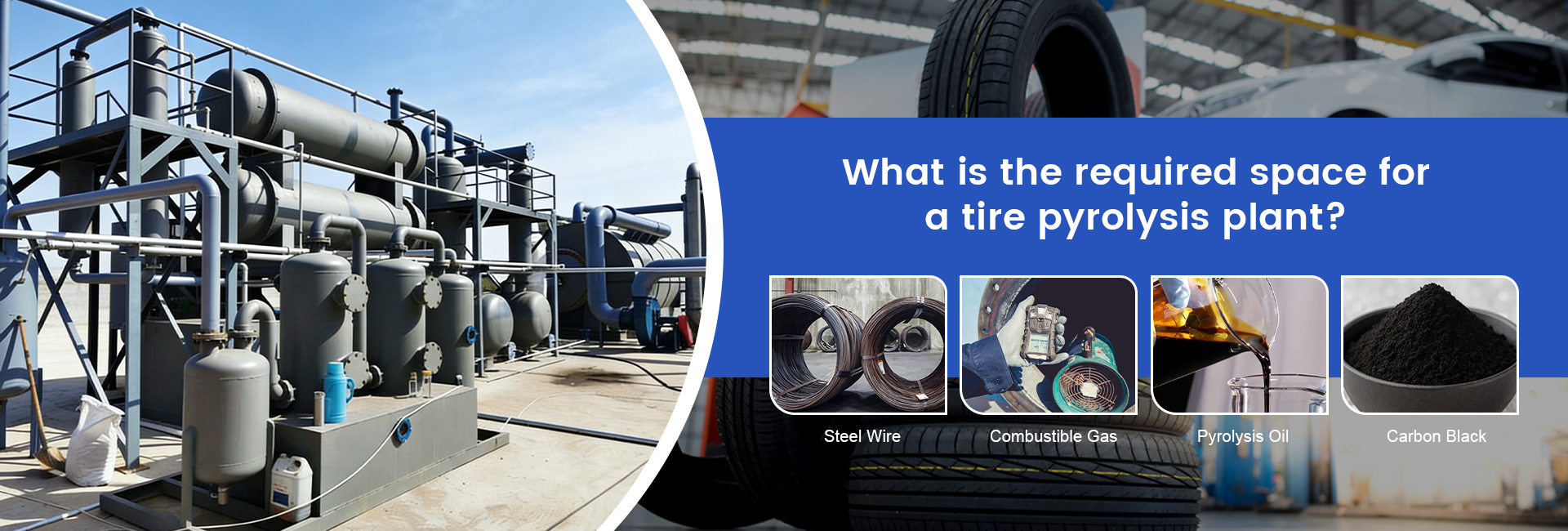
When consulting about tire pyrolysis plants, the first question from many clients isn’t about equipment pricing, but rather: “Can my existing site accommodate a tire pyrolysis unit?”Due to limited factory floor space, high land costs, and increasingly stringent environmental regulations, many projects face strict constraints from the very beginning. Natiijo ahaan, inadequate preliminary spatial assessments often lead to downstream issues, such as installation conflicts, forced layout modifications, or even project delays. In fact, there is no fixed answer to how much space a tire pyrolysis production line requires. What truly determines the footprint is whether the equipment configuration is reasonable and whether the system design is professional.


Batch vs Continuous Tire Pyrolysis: Which Takes Less Space?
Many investors assume that tire batch pyrolysis systems always save space, because they use fewer core units. Therefore, initial footprint appears smaller. However, auxiliary equipment and material handling often occupy additional space over time. Continuous systems require more equipment; meanwhile, they integrate feeding, reaction, condensation, and discharge into a streamlined process.
| Type | Awood (per day) |
Typical Area | Main Equipment | Automation Level | Environmental Configuration | Long-Term Economic Benefits |
|---|---|---|---|---|---|---|
| Batch Tire Pyrolysis Unit | 10–15 tons | 800–1500 m² | Batch pyrolysis reactor, condenser, oil tank, basic flue gas system | Low | Basic | Lower |
| Continuous Tire Pyrolysis System | 15–30 tons | 3000–5000 m² | Continuous pyrolysis reactor, automatic feeding, multi-stage condenser, carbon discharge system, full environmental units | High | Comprehensive | Higher |
Although continuous tire pyrolysis plants require more planned space, they deliver significantly higher efficiency and stability.
Therefore, for medium and large-scale projects, continuous tire pyrolysis systems offer better long-term land-use efficiency and return on investment.
Why Do Tire Pyrolysis Plants with the Same Capacity Require Different Space?
In actual projects, clients often observe a phenomenon: pyrolysis units for tires with similar processing capacities can vary significantly in footprint. The reason lies not in production capacity itself, but in the level of expertise in system design.
Case Study: How We Helped a Malaysian Customer Save Space?
In a waste tire pyrolysis plant in Malaysia, the customer had limited site space but required a daily processing capacity of 20 tons.
YUSHUNXIN customized a continuous tire pyrolysis production line for them, featuring the following key equipment:

Space-Saving Design Strategies
| Strategy Implementation | Implementation | Result |
|---|---|---|
| Modular Layout | Integrated pyrolysis, condensation, and environmental treatment units into a cohesive system | Reduced connection space by 30% |
| Vertical Design | Utilized vertical space for material handling and storage | Minimized horizontal footprint |
| Precise Path Planning | Optimized material flow and personnel movement | Eliminated redundant pathways |
| Future-Ready Interfaces | Reserved connections for future expansion | Original layout supports seamless upgrades |
How YUSHUNXIN’s Design Philosophy Ensures Space Efficiency?
In YUSHUNXIN’s tire pyrolysis solutions, spatial planning forms a core part of system design from the outset. We go beyond supplying single machines and instead help customers achieve stable operation within limited space.