
回収液の特性評価を接続する, コンディショニング, 発電機の選択と電気的統合を 1 つのプロジェクト範囲内で行う.
Match pyrolysis-oil conditioning to the generator and operating duty.
Tire-derived and plastic-derived liquids differ in sulfur, solids, viscosity, light fractions and wax behavior. The generator package must be selected after fuel sampling and an agreed conditioning route.
Do not connect raw recovered liquid directly to a standard genset by assumption
The conditioning train should be based on representative fuel analysis and the engine supplier's written limits.
- 01Settling and bulk separation
- 02Filtration and solids control
- 03Water separation
- 04Temperature and viscosity conditioning
- 05Day-tank and fuel-supply control
- 06Compatible engine and exhaust system
Make the fuel and electrical boundaries explicit
A practical proposal connects fuel variability, generator duty and site infrastructure.
Fuel characterization
Analyze density, viscosity, 水, sediment, 硫黄, flash point, distillation behavior and any wax or halogen concern.
Engine compatibility
Confirm whether the application requires a heavy-fuel, dual-fuel or other approved engine configuration.
Duty profile
Separate continuous base-load, variable-load, standby and islanded-power applications; they impose different controls and redundancy.
Electrical integration
Define voltage, frequency, synchronization, transformer, switchgear, protection and any grid-connection requirements.
Plan storage, fire protection and emissions with the generator package
Commercial evaluation remains conditional on the local fuel classification and permitting route.
Storage and transfer
Use compatible tanks, bunding, ventilation, temperature control, filtration bypass management and spill response.
Quality release
Set a fuel release test and reject route so off-spec batches do not reach the engine.
Maintenance model
Budget for injectors, filters, lubricant monitoring, deposits and exhaust after-treatment based on actual fuel quality.
Energy balance
Compare recoverable fuel, internal thermal demand, generator consumption, auxiliary loads and usable net electricity.
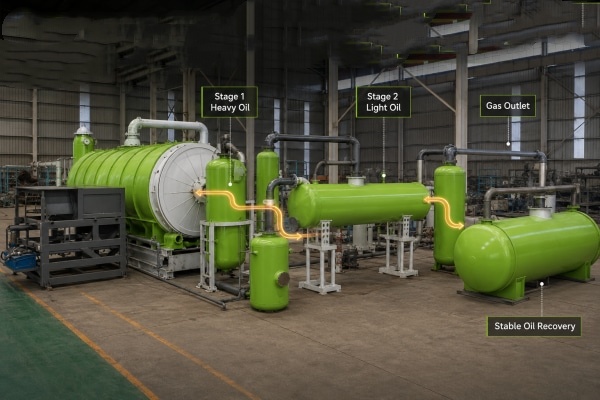
接続された機器の境界を確認する.
初期のレイアウトに関する議論をサポートするリファレンス ビジュアル. 最終装備, 配置やインターフェースはプロジェクト資料やサイトから確認.
プロジェクトの事実を機器リストに変換する.
この参照マトリックスは決定ロジックを示しています. 最終数量, モデルとインターフェースは承認されたプロジェクト提案に含まれます.
| システムブロック | 一般的な範囲 | 構成ベース |
|---|---|---|
| Bulk fuel handling | Settling, ストレージ, bunding and controlled transfer | Fuel classification and representative analysis |
| Conditioning skid | Filtration, water separation and temperature or viscosity control | Written engine fuel limits |
| Fuel supply | Day tank, circulation, metering, isolation and reject route | Duty cycle and off-spec management |
| Generator package | Compatible engine, controls, exhaust and safety systems | Approved fuel, load profile and maintenance basis |
| Electrical and heat recovery | Switchgear, protection, synchronization and optional heat interface | Site electrical boundary and usable energy demand |
必要な証拠が入手可能な場合にのみプロジェクトを進める.
各ゲートは、顧客情報を次の意思決定のために定義された技術的または商業的な成果物に変換します。.
Fuel evidence
Sample the recovered liquid and define batch variability.
出力Fuel-analysis and classification recordCompatibility review
Compare the analysis with written engine and conditioning limits.
出力Approved fuel-conditioning boundarySite integration
Define duty, electrical protection, ストレージ, fire and exhaust interfaces.
出力Single-line and interface basisCommercial proposal
Quote only against the approved fuel, duty and delivery boundary.
出力Traceable configuration and exclusions構成前に解決すべき質問.
答えはエンジニアリングの境界を定義します; これらは、代表的な材料試験や現地のコンプライアンスレビューに代わるものではありません。.
Can untreated pyrolysis oil be used in any diesel generator?
いいえ. 燃料分析, conditioning and written engine compatibility limits are required. Standard high-speed diesel engines should not be assumed compatible.
What fuel tests should be prepared?
Typical evaluation includes density, viscosity, 水, sediment, 硫黄, flash point, distillation behavior and any wax or halogen concern.
What is included beyond the generator?
The project may require settling, filtration, water separation, temperature control, ストレージ, day tanks, fire protection, switchgear, synchronization and exhaust treatment.
How should net electrical output be evaluated?
Compare usable conditioned fuel, internal thermal demand, generator consumption, auxiliary loads, operating duty and electrical losses under the agreed project basis.
機器を選択する前に材料を定義してください.
代表的な材料の説明を共有する, 利用可能なボリューム, サイトのステータスと目標の出力. YUSHUNXIN はこれらの事実を使用して、関連するプロセス境界と構成に関する議論を準備します。.


